GeoRoundtable Agency Evolution of Agency and Natural Philosophy
🧭 Agency · Natural Philosophy

Evolution of Agency and Natural Philosophy

Natural Agency M. Tomasello, 2022
Engineering Definition IEEE 2874-2025

Overview

Agents as relevant to Natural Philosophy

Agency is the most generalized organizational framework within which individuals formulate and produce their actions.

— M. Tomasello

An agent senses, responds, and maintains a model of its environment, while performing activities to achieve its goals.

— IEEE 2874-2025

Natural Agency

Evolution of Natural Agency

Agency predates contemporary AI. Agency in natural organisms is the most generalized organizational framework within which individuals formulate and produce their actions (Evolution of Agency, Tomasello, 2022). Agents decide for themselves what to do according to their own best judgment in a given situation. Types of psychological agents in evolutionary order of emergence are shown in the Table.

Each new form of psychological organization represented increased complexity in the planning, decision-making, and executive control of behavior. Each also led to new types of experience of the environment and, in some cases, of the organism's own psychological functioning, leading ultimately to humans' experience of an objective and normative world that governs their thoughts and actions.
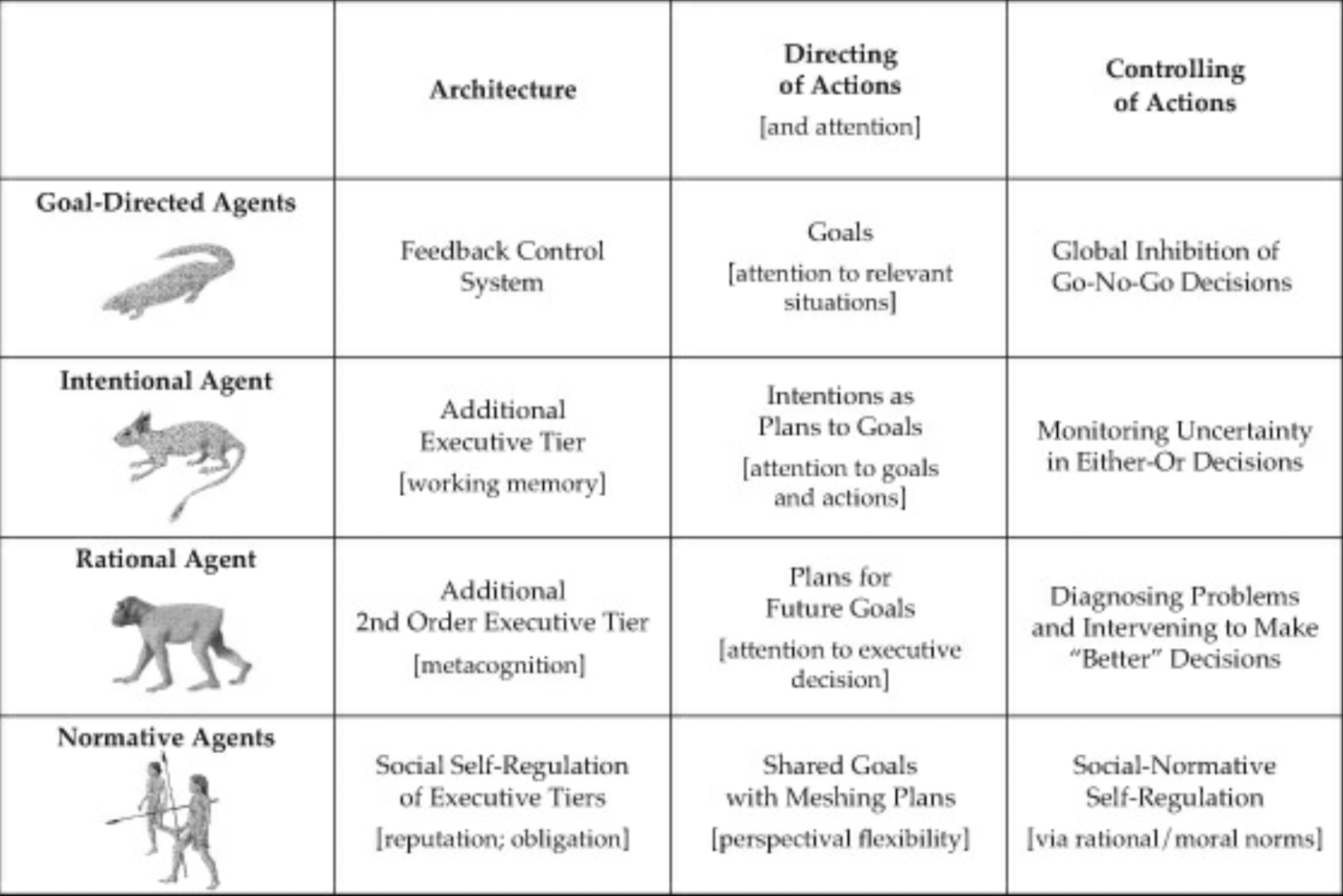
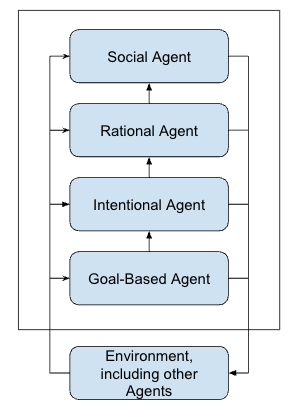
Table of agents in evolutionary order of emergence: Goal-Directed Agents (lizards), Intentional Agent (squirrels, rats), Rational Agent (great apes, chimpanzees), and Normative Agents (human groups), each row showing Architecture, Direction of Actions, and Controlling of Actions.
Table. Agents in evolutionary order of emergence (Tomasello, 2022)

Agent Functions

Agents: Functions and Operations

Agent types are distinguished by the functions they perform (Norvig) which are visible through behavior or statements of the agent's developer.

Canonical Agent Types as a hierarchy: Social Agent, Rational Agent, Intentional Agent, and Goal-Based Agent, each built on Environment, including other Agents, with feedback loops among all levels.
Figure. Canonical Agent Types as a hierarchy.
Table. Agent Types defined by the Functions they perform
Agent Type Agent Functions (cumulative going down)
Goal-Directed Agent
  • Sense and actuate the environment
  • Memory
  • Model creation and update
  • Goal recognition
  • Feedback control based on model and goals
Intentional Agent
  • Models beliefs, goals, intentions (what it's committed to doing)
  • Utility based planning and decision-making
  • Curiosity
  • Vicarious, trial and error: OODA loop
  • Monitoring uncertainty in decisions: inhibition, cognitive flexibility
Rational Agent
  • Causal models: plan for future goals, causal learning
  • Assess value of additional information, prior to decision
  • Reflective executive tier
  • Controller selection
  • Attribute mental states to other agents
Social Agent
  • Joint goals with other agents
  • Joint planning
  • Coordinating roles during activities
  • Awareness of rational and moral norms
  • Mediation between agents
  • Shared world models
  • Care

Emergent Structures

Agency is based on emergent structures.

Emergent Form provides the basis for Agency.

Kantian Wholes

An organized being is then not a mere machine, for that has merely moving power, but it possesses in itself formative power of a self-propagating kind which it communicates to its materials though they have it not of themselves; it organizes them, in fact, and this cannot be explained by the mere mechanical faculty of motion.

— Kant, Critique of Judgment, 1790

One way to get to exist as a complex entity in the non-ergodic universe is to be a living evolving "Kantian Whole."

— Kauffman, Eros and Logos (Kantian Wholes), 2020

Schemas by Complex Adaptive Systems

A complex adaptive system acquires information about its environment, identifying regularities in the information, condensing the regularities into a kind of 'schema' or model, and acting in the real world on the basis of that schema.

— Murray Gell-Mann, The Quark and the Jaguar: Adventures in the Simple and the Complex, 1994

Maintenance of Identity

Autonomy and diversity, the maintenance of identity and the origin of variation in the mode in which this identity is maintained, are the basic challenges presented by the phenomenology of living systems to which men have for centuries addressed their curiosity about life.

— Maturana and Varela, Autopoiesis and Cognition, 1972

Related Work

Further Reading

Natural Philosophy — Agency → Agency of Agents — Epistemological Approach → Epistemology in an Ecosystem of Agents → IEEE 2874-2025 Standard →

Discuss Agency & Natural Philosophy

Interested in the natural philosophy of agency or its application to agentic AI design? Get in touch.

✉️  percivall@ieee.org